What 380 turfgrass researchers are working on in 2025
This is the second annual analysis of research abstracts presented at the ASA-CSSA-SSSA Annual Meeting. I used clustering models to group 199 abstracts into turfgrass research topics. Here’s what turf scientists are focused on this year.
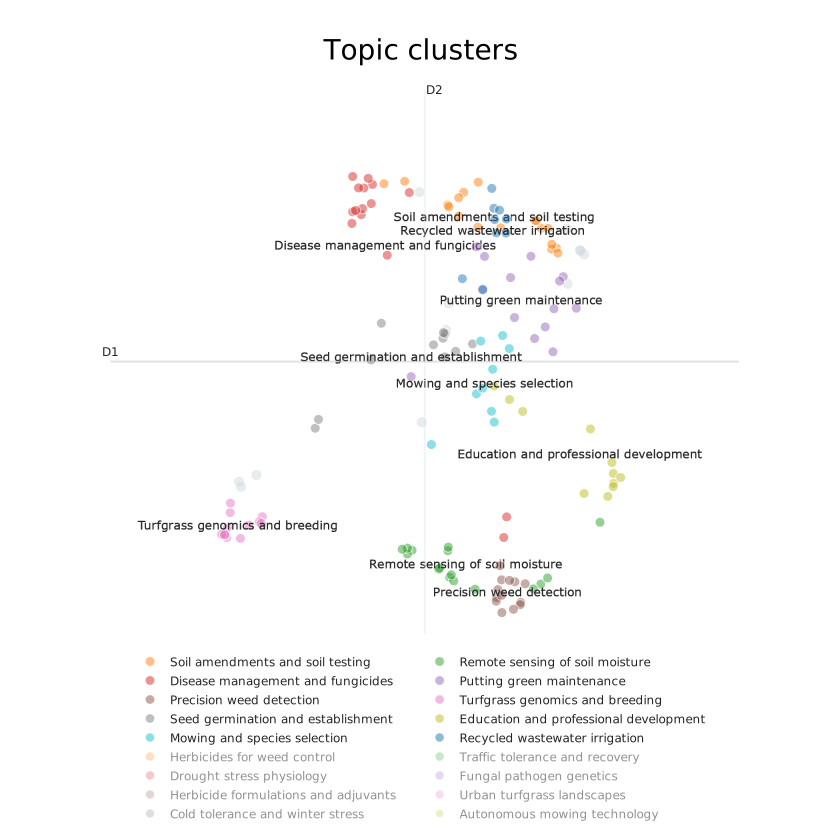
On desktop, hover over points to see abstract titles. Click topics in the legend to toggle them on and off and explore their distribution in the embedding space.
Top turfgrass research areas in 2025
These are the top problems the industry is trying to solve, and this is where resources are flowing. The top 5 research topics in 2025 are:
1. Soil amendments and soil testing · 9% of abstracts
Compost and organic amendments, carbon sequestration and soil health, soil test interpretation, soil sampling protocols
2. Remote sensing of soil moisture · 8% of abstracts
Machine learning for soil moisture mapping, UAV imaging, hyperspectral and thermal imagery, ground-penetrating radar, L-band radiometry
3. Disease management and fungicides · 8% of abstracts
Dollar spot, large patch, spring dead spot, IPM, fungicide efficacy, nitrogen and PGR impact
4. Putting green maintenance · 7% of abstracts
USGA spec greens, sand topdressing, organic matter management, nitrogen and rolling, surface firmness
5. Precision weed detection · 7% of abstracts
Computer vision for weed detection, UAV-based weed detection, vegetation indices, site-specific herbicide application, machine-vision sprayers
About the conference
The ASA-CSSA-SSSA Annual Meeting (now going as CANVAS) is the largest academic conference for turfgrass science in North America. The turfgrass division (C-5) is part of the Crop Science Society of America (CSSA), and all abstracts are available in the conference program.
I got 250 C-5 papers using the conference API. After removing blank entries, the dataset contained 199 abstracts from 384 authors.
Like last year, I used SPECTER embeddings that were developed for scientific papers. Then BERTopic clustered similar abstracts together.
Full topic table
This year’s analysis identified 18 distinct clusters. The table below shows the topics, count of abstracts, proportion of total, top words that represent each topic, and the topic name. The first row, topic -1, is outlier abstracts that don’t fit well into other topics. The outlier results are useful information in that they’re truly unique papers.
| Topic | Count | Proportion | Representation | Topic name |
|---|---|---|---|---|
| -1 | 11 | 0.06 | cleat, cores, nir, cleat cleat, sterility, ppn, mg, samples, clay, zjacos24 | Outliers |
| 1 | 18 | 0.09 | compost, qst713, amendments, soil, applied, soil test, fertilizer, turfgrass, nutrients, galeatus | Soil amendments and soil testing |
| 2 | 16 | 0.08 | moisture, ground, soil moisture, irrigation, machine learning, gpr, vwc, stadium, soil, machine | Remote sensing of soil moisture |
| 3 | 15 | 0.08 | disease, dollar, dollar spot, spot, fungicides, severity, large patch, fungicide, patch, disease severity | Disease management and fungicides |
| 4 | 14 | 0.07 | sand, brd, putting, topdressing, greens, firmness, sand topdressing, putting greens, biochar, layer | Putting green maintenance |
| 5 | 13 | 0.07 | weed, weed detection, detection, turfgrass, imagery, uav, vision, precision, indices, images | Precision weed detection |
| 6 | 12 | 0.06 | genomic, genome, genetic, qtl, haplotype, ploidy, markers, breeding, lf, diversity | Turfgrass genomics and breeding |
| 7 | 11 | 0.06 | germination, kb, seed, tf, dormancy, planting, establishment, kbg, gibberellin, seeding | Seed germination and establishment |
| 8 | 11 | 0.06 | professional, turfgrass science, certification, mentorship, mentoring, agencies, teachers, public, turfgrass, professionals | Education and professional development |
| 9 | 9 | 0.05 | mowing, fraise, fraise mowing, mowing requirements, clover, requirements, entries, microclover, seed, species | Mowing and species selection |
| 10 | 9 | 0.05 | rww, nutrient, gypsum, bicarbonate, fertilizer, irrigation, florida, bpcu, recycled wastewater, blackout | Recycled wastewater irrigation |
| 11 | 9 | 0.05 | goosegrass, methiozolin, control, topramezone, bensulide, metribuzin, postemergence, ha, yr, sequential | Herbicides for weed control |
| 12 | 9 | 0.05 | traffic, fraise, trafficked, wear, playability, recovery, hardness, fields, surface, surface hardness | Traffic tolerance and recovery |
| 13 | 8 | 0.04 | drought, drought performance, bulk, tolerance, root, tc, dalz 1606, 1606, traits, drought tolerance | Drought stress physiology |
| 14 | 8 | 0.04 | isolates, clarireedia, genes, dollar, dollar spot, sdhi, spot, qoi, insensitivity, mutations | Fungal pathogen genetics |
| 15 | 8 | 0.04 | formulation, ems, granular, formulations, el, callus, ppo, quinclorac, flumioxazin, kyllinga | Herbicide formulations and adjuvants |
| 16 | 7 | 0.04 | lawn, vr, runoff, landscape, urban, landscapes, greenspaces, tree, shade tree, glyphosate | Urban turfgrass landscapes |
| 17 | 7 | 0.04 | ice, ice encasement, encasement, carbohydrate, stress, anaerobic, physiological, freeze tolerance, antioxidant, tolerance | Cold tolerance and winter stress |
| 18 | 4 | 0.02 | mowing, autonomous, robotic, robotic mowing, mower, mowers, centipedegrass, conventional, rotary, mowing frequency | Autonomous mowing technology |
Topic confidence
The model assigned 94% of abstracts to a specific topic, and 81% of those were assigned with high confidence (probability > 0.5). The low confidence areas make sense when you read through them, for example:
Seed germination and establishment(topic #7): Combines seed dormancy physiology with field establishment protocolsHerbicide formulations and adjuvants(topic #15): All about plant responses to chemicals, but mixes herbicide adjuvants and formulations with mutagenesis breeding (EMS mutagenesis uses a chemical mutagen)
Language models cluster text by shared vocabulary. This is apparent in these low-confidence topic assignments. The abstracts share enough terminology that the model groups them together, but the model’s uncertainty is informative. It takes domain expertise to troubleshoot these results.
The model initially generated 29 topics. I merged similar ones to get the 18 shown above. Starting with a few too many topics and consolidating them is faster than trying to split broad clusters.
Heatmap visualization
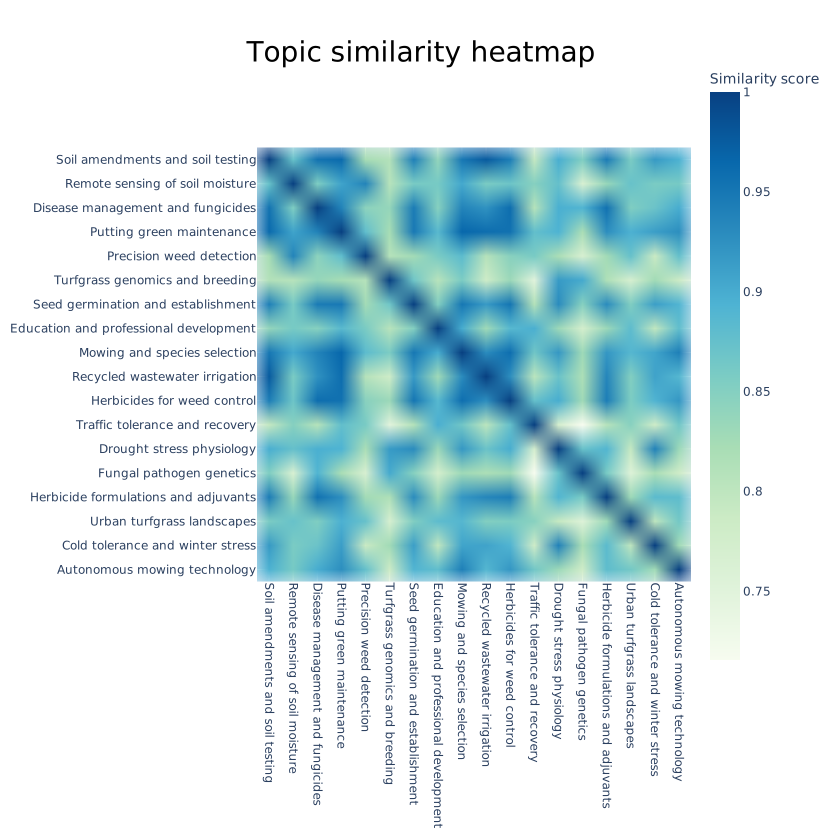
The heatmap below shows how similar topics are to each other. Darker colors indicate stronger similarity between topics. On desktop, hover over any square to see the similarity score.
Similarities highlight where researchers are using shared methods or talking about overlapping constraints. For example, mowing and species selection is similar to autonomous mowing technology, and herbicides for weed control is similar to disease management and fungicides. On the other hand, turfgrass genomics and breeding is not at all similar to traffic tolerance and recovery.
Comparison to 2024
Here’s how 2025 compares to last year:
- Soil stuff jumped from #4 to #1. Soil topics made up the largest cluster of research focusing on amendments, soil testing philosophies and ROI, and nutrient leaching prevention. Carbon sequestration, which was its own small topic last year, merged into general soil management this year.
- Remote sensing work continues to dominate. Last year remote sensing was the #1 topic. This year it was so big the topic modeling actually separated remote sensing work into two smaller subtopics: remote sensing of soil moisture and precision weed detection.
- Dollar spot research increased with work in multiple topic clusters, including resistance and population genetics. Consistent work on applied management of dollar spot continues.
- Autonomous mowing tech emerged as its own research cluster this year. The tech has matured into deployment and optimization phase. Researchers are thinking about “how do we do this better?”
- Cold tolerance and winter stress formed its own cluster this year, reflecting WinterTurf project momentum.
- Zoysiagrass breeding is particularly active. Last year included genetics work, but this year’s conference added high-end genomics. Zoysia appeared in multiple topic clusters and is proving importance as a low-input warm-season grass with exceptional stress tolerance.
- The topic modeling improved. This year I was able to classify 81% of abstracts with high confidence, compared to 70% last year. This means 2025 abstracts formed more distinct and separated clusters. Could be either because the research topics themselves were more differentiated, my topic modeling better captured the structure in the data, or both.